
 Image 1 of 1
The Waiting Game: A Wartime Story of Two Young Women
This story follows the lives of two young girls from being school-friends to joining the WRNS and Land Army during the Second World War.
Ginnie joins the WRNS, where she is drafted to Chatham and falls in love with a young Irishman, Lieutenant Kevin O’Sullivan. He is on board a minesweeper; a dangerous assignment which will eventually lead to tragedy for his family and Ginnie.
Anita trains for the Land Army and has a disastrous love affair with American serviceman Ricky Dorado. She is going to have his baby but he has disappeared and cannot marry her anyway. The birth of the baby causes terrible friction at home and Anita has to leave.
At the end of the war Ginnie is demobbed and contemplates the idea of becoming a teacher. Visiting her old school she meets a new young man. Whilst, via Ginnie’s introduction, Anita falls in love with Kevin’s brother, Patrick.
The end is, in a way, a new beginning for both girls; as was the case for so many following the last days of the Second World War. Their story captures the very essence of life in 1940s Britain, when it was very much ‘a waiting game’.
ISBN: 9781852000929
Size: 217x140mm
Binding: hardback
Length: 195pp
This story follows the lives of two young girls from being school-friends to joining the WRNS and Land Army during the Second World War.
Ginnie joins the WRNS, where she is drafted to Chatham and falls in love with a young Irishman, Lieutenant Kevin O’Sullivan. He is on board a minesweeper; a dangerous assignment which will eventually lead to tragedy for his family and Ginnie.
Anita trains for the Land Army and has a disastrous love affair with American serviceman Ricky Dorado. She is going to have his baby but he has disappeared and cannot marry her anyway. The birth of the baby causes terrible friction at home and Anita has to leave.
At the end of the war Ginnie is demobbed and contemplates the idea of becoming a teacher. Visiting her old school she meets a new young man. Whilst, via Ginnie’s introduction, Anita falls in love with Kevin’s brother, Patrick.
The end is, in a way, a new beginning for both girls; as was the case for so many following the last days of the Second World War. Their story captures the very essence of life in 1940s Britain, when it was very much ‘a waiting game’.
ISBN: 9781852000929
Size: 217x140mm
Binding: hardback
Length: 195pp
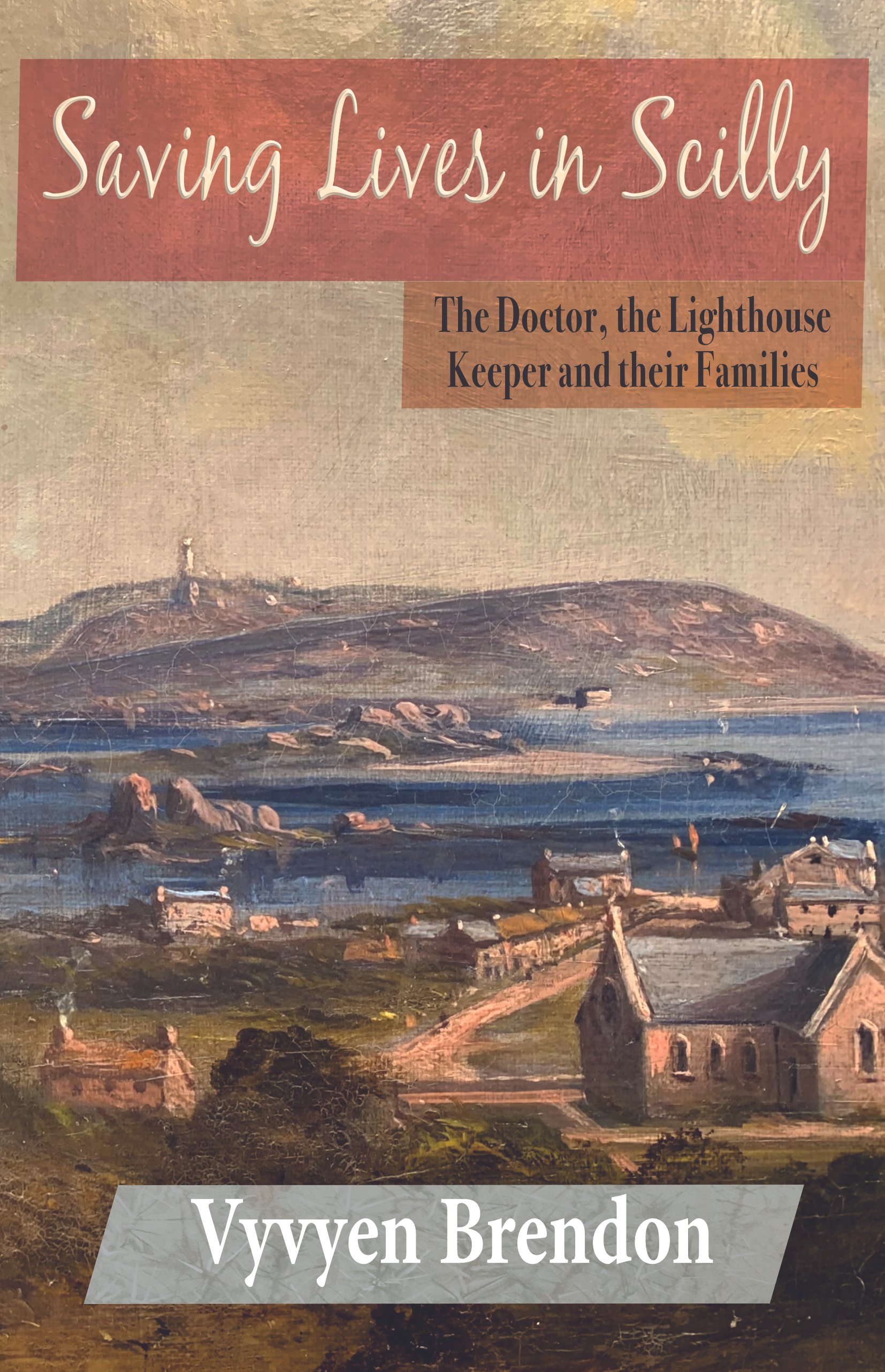
Saving Lives in Scilly: The Doctor, the Lighthouse Keeper and their Families
This is the story of the author’s two paternal great-great-grandfathers, both of whom spent over forty years helping to save lives on the Isles of Scilly: Edwin Lewis Davis as the keeper of St Agnes Lighthouse and John Grenfell Moyle as the islands’ only doctor. It also follows the mariners, miners, preachers and teachers of the Moyle and Davis families as they become part of the great Cornish diaspora. We accompany them over the seven seas aboard speedy clippers, to the Antipodes during the gold rush, to the industrial north of England, to lighthouses along rugged coastlines and to the war zones of the Crimea peninsula and the Western Front. With them we enter Victorian classrooms, workhouses, prisons and lunatic asylums.
The book is richly illustrated with images of people, places and mementoes, including the paintings of John Grenfell Moyle, who became a renowned West Country artist. Quotations from contemporary writers such as Charles Dickens, George Eliot, Wilkie Collins and Mrs Gaskell help to transport readers into the world inhabited by the author’s forebears and their own. She pays particular attention to the lives of great-grandmothers and great-aunts, which have so often been hidden from history.
Saving Lives in Scilly will appeal to readers with an interest in the sea, the West Country, lighthouses, medicine, the lives of women and in social history. In addition, those keen to explore their family’s past will find inspiration in the author’s journey of discovery.
ISBN: 9781852002176
Size: 217x140mm
Binding: hardback
123 Photos
Length: 284pp

The year is 1789, and Eddy Adams awaits execution in Newgate Prison along with French puppeteer Henri Castillou. His escape is enabled by Calvert, an enigmatic gentleman who, from that moment on, appears to have an altruistic interest in saving Eddy at times of danger.
As a fugitive from the authorities, Eddy’s life takes on a momentum of its own. He becomes entangled with a band of highway robbers, falls in love with an extraordinary woman called Rumer and, on discovering he has a gift for carving wooden figures, is befriended by Italian puppeteer Giovanni Piccini, performer of the popular Punch & Joan street show.
With the Bow Street Runners hot on his heels, Eddy’s escape leads to him being taken prisoner by the French. The French Revolution is in full flow, and it is Calvert who once again comes to Eddy’s aid, reuniting him with fellow escapee Henri and his wayward wife Cécile. After experiencing life farming in the Pyrenees, Eddy finds himself responsible for Cécile and her son on a hazardous return to England.
Back in London, Eddy discovers a passion as a performer of the popular Punch & Joan street show, soon to become known as Punch & Judy, and reunites with his friend Piccini.
Finally settled after all his amazing escapes and adventures, Eddy needs to learn the identity of the man who made all this possible – his lifetime saviour Calvert.
ISBN: 9781852002039
Size: 212x135m
Binding: paperback
Length: 450pp aprox

Lust, deceit and disease lurk within the strange painting called An Allegory with Venus and Cupid created by Bronzino in Florence around the year 1540 and now hanging in the National Gallery in London. Venus and Cupid are nude and kissing lasciviously. Also in the painting are Time; a screaming figure; a person or mask with the back of its head missing and a weird creature, whose upper part is a pretty girl and lower half some kind of reptile.
The meaning of the painting is a mystery. At present it is thought to be about syphilis, but it was probably a diplomatic gift sent to King Francis I of France when he was dying, possibly of syphilis: would he have appreciated a painting about the disease that was killing him?
The Riddle of Bronzino takes a relaxed, discursive look at the figures and objects in the painting and at when, why and how it was created. This leads to the discovery of a new multi-layered solution to the riddle of its meaning and shows that, as well as being a beautiful object of historical interest, the Allegory is a psychologically penetrating image of relevance today.
ISBN: 9781852001902
Size: 217x140mm
Binding: hardback
17 colour plates and illustrations
Length: 383pp

By focusing on the first 23 years of his life living at New Cross, S.E. London, author Valentine Barnes, now in his 90th year, has managed to encompass a wealth of social history from the period leading up to and just beyond the Second World War.
The housing block of the title is that of Dennett’s Road and its surrounds, and Valentine Barnes remembers the families and businesses that used to reside and ply their trades within this area in the 1920s and 30s. These include the local greengrocers owned by his grandparents, the local cinema, newsagents, ice cream sellers, the barber, bakers and others, all of whom made up a close community that, together with a strictly disciplined schooling, produced a cohesive and caring neighbourhood.
Valentine remembers his first day at school and reflects on pre-war education, he recollects trips to Southend, Ramsgate, Margate and Clacton with his grandmother on pre-war paddle steamers, and recalls experiences in the Second World War when, still well under age, he donned his Light Rescue uniform with his companions to pull the dead and injured from the wreckage and carnage of German bombings.
From the simple joys of collecting cigarette cards or playing on 1930s streets that were mainly devoid of motor vehicles, through to the terror of the air raid sirens during the Blitz and the social changes caused by World War II, Valentine shares his experiences and understanding of those far-off days from a perspective that can only be gained by having lived through them.
ISBN: 9781852001858
Size: 217x140mm
Binding: Hardback
68 colour and b&w photos
Length: 283pp
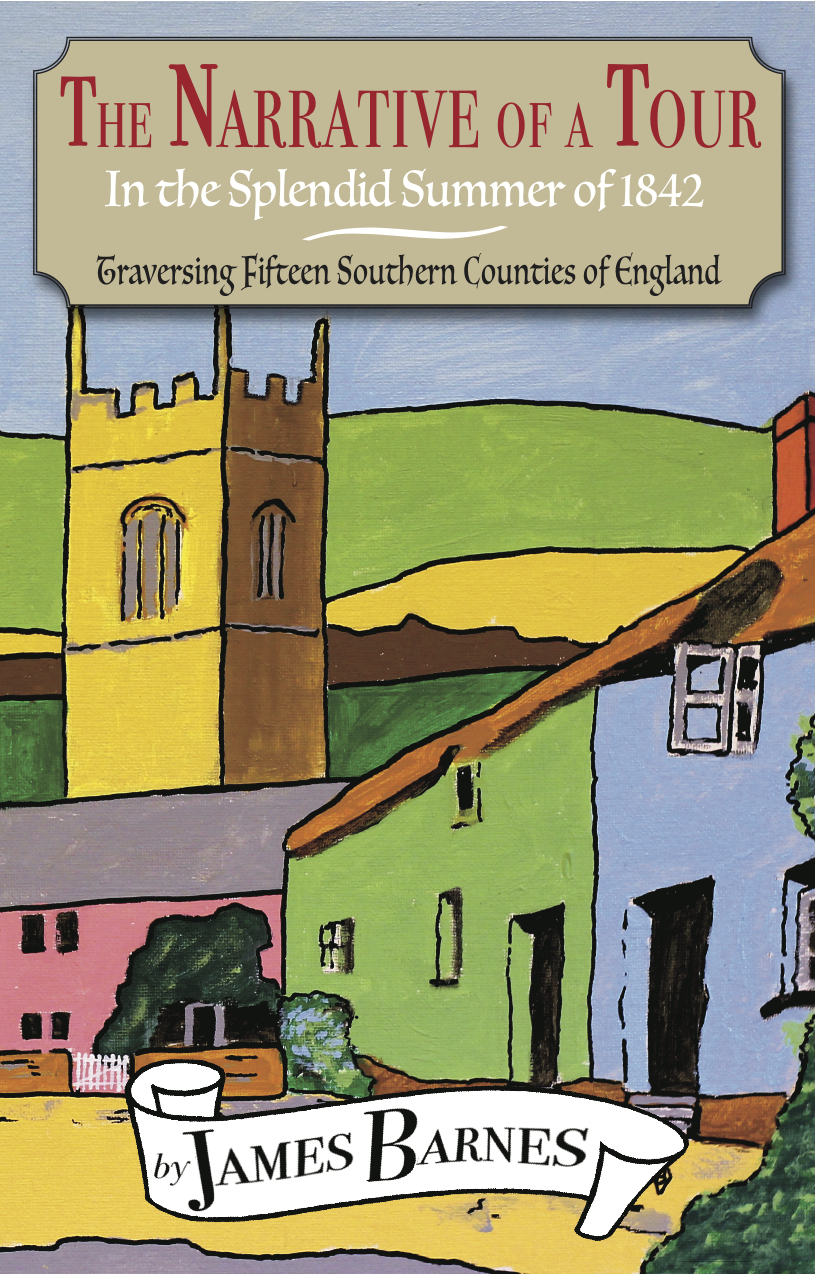
The Narrative of a Tour in the Splendid Summer of 1842: Traversing Fifteen Southern Counties of England
The text in this book is taken entirely from the 1842 hand-written travelogue of James Barnes, who, with his wife Mary, set off from Peckham in Surrey to travel in a pony and chaise around some fifteen counties of Southern England.
In following the couple's experiences while travelling in the mid-19th century, we are able to view the people and places exactly as they were 174 years ago: a time when Queen Victoria reigned; the first photograph appeared in The Times; Charles Dickens' American Notes were published and Isambard Kingdom Brunel's great ship, the SS Great Britain, was under construction.
The accounts of places visited include Lyme Regis, where just three years previously the famous landslip had occurred; their encounter with a floating bridge at the River Itchen; a visit to Mr Fish's Marine Villa and to the Goodwood races, as well as the house and grounds of Earl Powlett in Somerset. There's also a disturbing encounter with bed bugs in an inn, and the Irishman who lived with his family and animals in a cave about 200 feet from the beach at Hastings: all diligently documented under candlelight at the end of their journey by James himself.
We learn about the social customs of the day, and the changes in society that were still in upheaval from the 'Great Revolution caused by the introduction of Machinery and Steam power'. Here we are able to 'live' history.
Along with the text there are around 50 black and white illustrations from the period and also notes at the end by the author's great-great-grandson, Valentine Barnes, who fortunately unearthed this rare narrative for all to enjoy.
ISBN: 9781852001803
Size: 217x140mm
Binding: Hardback
50 b&w illustrations
Length: 171pp

Forgotten Genius: A Celebration of Past Engineering Craftsmanship
All around Britain lie the relics of past engineering genius. Many of these are in museums, some lie half-buried in disuse, and a few still help to provide a living in the 21st century. However, there is no doubt whatsoever that those who crafted these machines, tools and other devices, have left a legacy of technical expertise that remains intact and in use to this day.
Forgotten Genius is an account of this craftsmanship, acknowledging the determination and inventiveness of the people that brought about the enormous commercial and physical changes which mainly took place during the Industrial Revolution, during the years 1740-1840.
As well as the well-known engineers from the period, such as Brunel, Wren, Watt, etc., there are many who have been all but forgotten, and yet there is no doubt that it was the perseverance, skill and imagination of all these men, often from humble backgrounds and with little or no formal education, that led to a flourishing British economy and an increased standard of living for all.
This book deals with the inspiration, processes, products and mechanisms behind our engineering heritage in the 18th and 19th centuries, and considers the measuring instruments, materials, transport and power which were necessary to implement the enormous changes in mechanisation taking place at that time. There is also reference given to the changes in work practice, apprenticeships, and the adjustment of society in general due to the growth of factories harnessing the best use of industrial methods.
Accompanying the text are illustrative drawings and photographs, all helping to show the incredible skill of our predecessors.
ISBN: 9781852001544
Size: 217x140mm
Binding: hardback
Length: 145pp

Nancy Vlasto has led an extraordinary life. Born to a famous surgeon in the roaring '20s, she began life in a comfortable Bayswater home complete with servants. By age nine, she was starring in a Pathé newsreel as a young tennis star. But by the outbreak of WWII, the feisty young Nancy had chosen to swap a world of privilege for `a life well lived'. As Nazi bombs rained down on London, she worked in a children's hospital, bravely staying above ground with little ones too sick to take to the shelters. Later, she worked as a midwife and district nurse amid the postwar poverty of the East End.
But the irrepressible Nancy always found time for fun - from wartime parties to going naked in the Turkish baths at Paddington. And by the '50s she had discovered a taste for performing. She made TV appearances before heading to Canada in search of fresh adventures - ending up running her own hugely popular radio programme for children. Back home, Nancy turned her talents to a career as a health visitor before she eventually became the deputy headteacher of a special school. Now - well into her 80s - she continues a lifetime of fundraising dressed as `Blossom' the panto-style horse. She's taken tea with The Queen, enjoyed many honours from grateful colleagues and organisations and nurtured a lifelong love of music and singing.
Here Nancy shares a wealth of memorable stories from every exciting
episode of her life, bringing each era vividly to life. She shares the sometimes moving, often funny and always illuminating characters and scrapes she has enjoyed along the way. This hugely enjoyable memoir brings Nancy's adventures to life - showing what life was like for an indefatigable working woman across more than seven decades. Nancy has never lost the thrill of wondering what life can offer her. She celebrated her 80th birthday by swimming with dolphins and is still asking. . . what's next?
ISBN: 9781852001490
Size: 217x140mm
Binding: hardback
Length: 296pp
32pp photos

The year is 1794 and Jason Bradley is ordered to join the British Navy on a sloop-of-war to fight the French during the Napoleonic Wars.
Having completed a degree in Military History Jason has been hired by Admiral Blaine, who is in control of the Department of Special Operations within British Naval Intelligence, to gain sea experience so as to research and bring in fresh naval strategic ideas.
Jason joins the warship Sprite as a midshipman, carrying independent orders from Blaine which will not be known to his captain unless he is forced to use them. Soon learning the fatigue of manoeuvring sails and climbing the rigging, Jason is also discovered to have a lethal ability to control the heavy guns carried on the warship.
The crew's aim is to destroy the merchant shipping around the French Mediterranean coastline; something which, with Jason's knowledge and ability, they find they are particularly successful in achieving.
Following Lord Hood's forced withdrawal from Toulon he plans an assault on Corsica. The crew of Sprite are involved in this combined army-navy operation which gains Jason further sea experience, and subsequently Sprite is to operate from a new base at Bastia.
The exceptional success of Sprite's stealthy raiding stirs the ire of the French Navy and they become determined to search for, and destroy, Sprite.
ISBN: 9781852001407
Size: 217x140mm
Binding: hardback
Length: 280pp

In her third diary we follow Ingrid Jacoby's life through the first half of the 1950s from the age of 23 to 26 years.
Still in Oxford and now working for Rosenthals' Antiquarian Booksellers, she records relationships between all her work colleagues whilst finding a particularly deep attachment to Erica Spender, a worldly woman who sees in Ingrid something of her own spirit.
The intimacies and eccentricities of a number of boyfriends are brought to life throughout the entries and the names of Markus, WB, Alan, Jonathan, Antony, Peter and Michael weave in and out, coming and going, as either good or bad sexual encounters ensue or promises of more stable relationships occur.
At times Ingrid is sent into depression, will nothing work for her? She remembers, at the age of 12, being transported via Kindertransport from Vienna to Falmouth with her sister Lieselotte, discovering that her mother was lost forever after dying in a German concentration camp and subsequently being unable to properly find a close relationship with her father and his new wife. Holidays back to Austria and Falmouth help to build awareness and understanding, although still leave a sense of estrangement.
Finally though, there is a relationship that brings stability and reason to Ingrid. She meets and falls deeply in love with Stan, and as the pages of this third diary come to a close we know that her heart and life have become secure.
ISBN: 9781852001360
Size: 217x140mm
Binding: hardback
Length: 372pp
Illus: 26 b/w within text

Whilst being a tremendously well-researched work on Scottish heraldic heritage, this is not simply an account of Scottish history. The fact is that this book contains the stories of men and women who genuinely believed in their inheritance, their diversity and their ability to regain for Scotland and England a truly great kingdom; they are the Jacobites.
From the time of the Glorious Revolution in 1688 and James II’s fleeing the country, the Jacobite cause has existed. A strong belief that they should serve the proper and rightful King was their strength and ambition, and this feeling of existing for, and belonging to, the Jacobite movement is something which has been passed down in many families throughout Scotland across the intervening centuries.
The original mantle was passed from James II to James III and VIII de jure, and then on to Charles Edward Stuart, the man known to all as Bonnie Prince Charlie who fought at Culloden. Whilst this latter figure has been romanticised over the years, with his flight from the battlefield aided by Flora MacDonald, this book tells the story of all those others involved in the great Jacobite cause before that fateful day. It includes the stories of many other truly heroic women such as Clementina Sobieska, James III ’s wife and mother to Charles Edward, who travelled across the Alps incognito to marry the man she loved although she had never yet seen him in person.
These individual stories of men and women bound by a single cause make an interesting and compelling read, if sometimes tragic, and not all have previously been published except as parts of family genealogies. So this is probably the first comprehensive chronicle of those following that proud Jacobite cause.
ISBN: 9781852001292
Size: 217x140mm
Binding: hardback
Length: 174pp
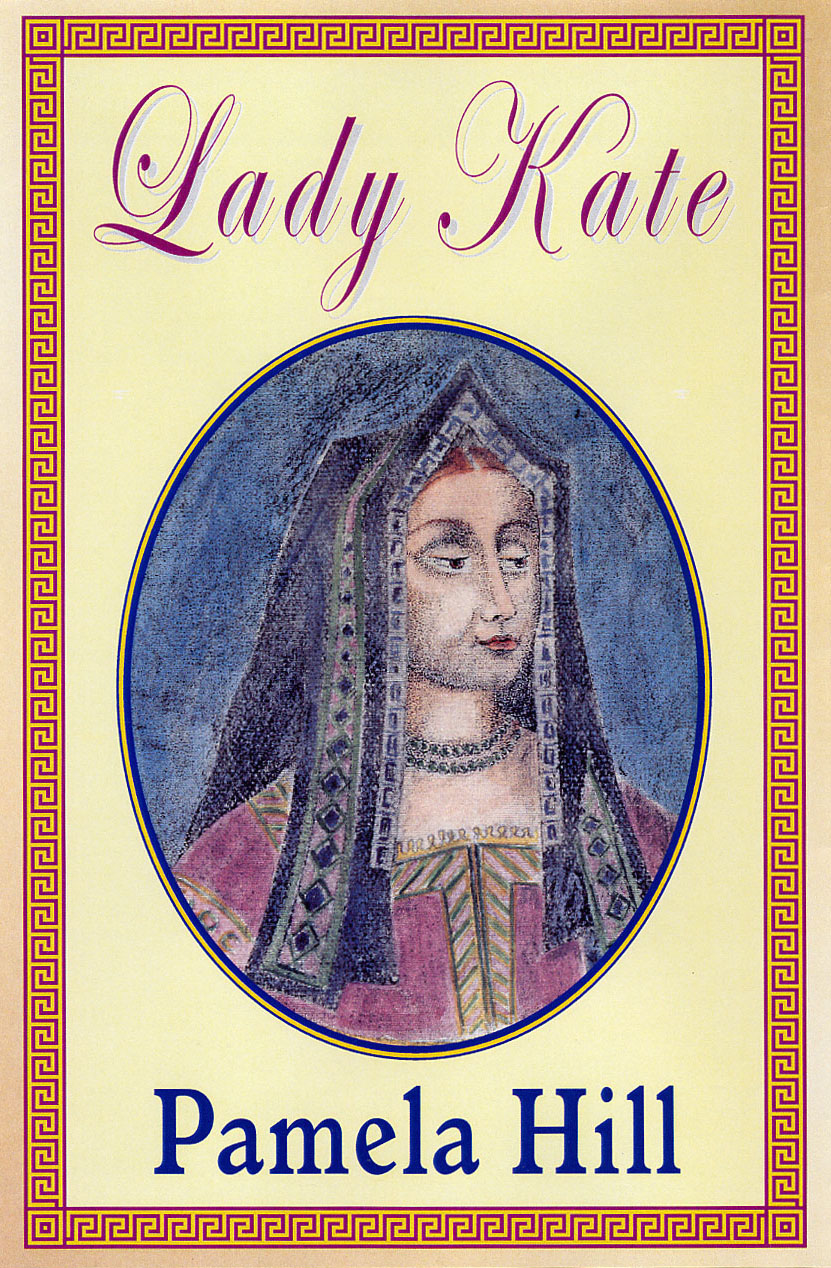
Lady Katherine Gordon, daughter of the much-married earl of Huntly, starts life with a handicap; she is uncertain which of her f ather’s wives had been her mother. Her courage and beauty overcome this uncertainty, and in course of a varied life she acquires the lasting devotion of her own king, James IV, and of many other men, four of whom she marries. A fifth is Henry VII, who surprisingly – he killed her first husband for political reasons – is recorded as desiring no other comfort than her company. Kate is generous enough to give it to him. She also greatly loves his queen.
Her story includes the tragedy of the stranger whose first bride she became, and who may or may not have been the younger of the sons of Edward IV said to have been murdered earlier in the Tower. This and the later marriages apart, the story of European entanglements connected with the desired marriage of Henry VII ’s son Arthur and an infanta of Spain, who later married his brother Henry VIII, make compelling reading. Through it all Kate continues wise, kindly and beautiful even in old age. She is one of the few people to have looked down on her own face in a tomb she did not occupy, leaving her third husband inside it and returning to where she had been happy with her second. She also, though differently, loved her young fourth husband, who was to carve out a future for himself after Kate died in 1537, the year Henry VIII at last got himself a son.
All these people come alive in Kate’s recollections, which include her grief at news of the Scots defeat at Flodden. Her brother, and ancestor of Lord Byron, was killed there with James IV, who had married Henry VII ’s daughter and in the end gave rise to the present royal family.
ISBN: 9781852001254
Size: 217x140mm
Binding: hardback
Length: 197pp

Attempts to solve the mystery surrounding the loss of his destroyer HMS Fortune, along with the complete Royal Navy convoy HXL 267, in September 1943, lead Commander Bob Garner into even more dangerous waters than those of the North Atlantic.
Although exonerated of blame, he is dismayed that his superiors do not accept his report that the convoy was attacked by an exceptionally fast submarine. There also seems to be an unwarranted secrecy about the purpose of the defeated convoy.
Traumatised by the loss of the Fortune and the lack of reaction by his superiors, he finds his personal life in turmoil and wife Melissa unable to cope with his state of mind; his only solace in the form of Mary Forbes, a sympathetic Wren officer.
Meanwhile the captured Frigatten Kapitan Hinterberger seems to know about the sinking of the British convoy, but teases Bob Garner, holding back on any real information.
As the truth unfolds regarding the loss of convoy HXL 267, the war service of German Kapitan Hinterberger, the secret of the high speed submarines and the purpose of ‘Operation Cloudburst’, Commander Bob Garner shares his place on the stage of history with figures such as General Eisenhower, Adolf Hitler and Gross Admiral Doenitz, who led the U-boat campaign, together with double agent Garbo and the mysterious Committee XX.
ISBN: 9781852001247
Size: 217x140mm
Binding: hardback
Length: 291pp

My Darling Diary : Volume Two - The Girl in and Out of Love - Oxford 1944-1950
Following Ingrid Jacoby’s first published diary, which dealt with her wartime arrival in Britain under the Kindertransport movement at the age of 12 and subsequent life through to 1944, Ingrid Jacoby’s second My Darling Diary records her life from late in 1944 through to 1950.
During these years Ingrid lives in Oxford, where she works at the Central Library for a while and then at Parker ’s Bookshop. Throughout her encounters with those in charge and with various colleagues and friends, her diary reflects the deep thoughts and feelings of a girl ’s coming of age in Britain during the 1940s.
It is the honesty and frankness of Ingrid’s diary that entices the reader to read on; whether it is her unprovoked lecherous encounter with the famed singer Richard Tauber or her own feelings of love for various men who wend in and out of her life, we know that the sentiments are real, being told directly to us as the diary takes on a persona of its own.
There are times of loneliness, times of desire, sexual experiences with ‘WB’ her married boss at the bookshop and with boyfriends, all interwoven with feelings of inadequacy, doubt, and the myriad of emotions attached to any young woman from any age. However, this is Ingrid ’s story, and in so being is also completely original, enticing and compelling to read.
ISBN: 9781852001230
Size: 217x140mm
Binding: hardback
Length: 412pp

Prinny Remembers - the Private Reflections of His Majesty King George the Fourth
Thackeray cruelly wrote of George IV as no more than a tailor’s dummy. Later verdicts have been founded on this. A more recent one states that he was ‘an undutiful son, a bad husband, and a callous father,’ without finding very much to say against his kingship.
None of the above is accurate, given the knowledge of lately revealed letters from George Augustus himself and those of his daughter, Princess Charlotte. George, better remembered as Prince Regent and often called Prinny, was in many ways a secretive man despite his outward flamboyance. Hints here and there in the Princess ’s letters show him as an affectionate father in private. In public, his attitude to her had to be ambivalent because her mother, long estranged from him by her own choice, made common cause with his political enemies, and what has generally been put down to caprice can be seen, knowing the facts, as statesmanship.
This charming, gifted and intelligent man contrived, despite an appalling hereditary illness concealed with great courage, to give his name to a brilliant Regency and thereafter to reign as King for a further ten years.
Prinny Remembers is an attempt to reconstruct the probable thoughts and memories of this secret man, dying almost alone at Windsor, old, ill and blind, in 1830, and put right the biased press usually given to him.
ISBN: 9781852001223
Size: 217x140mm
Binding: hardback
Length: 251pp

It is September 1952, and eighteen-year-old Peter Rundle has no idea of the adventure awaiting him when he reports for National Service with the Duke of Cornwall ’s Light Infantry. Already a capable boxer, he knows he will learn how to use lethal weaponry, and he is not unduly surprised by his posting to Germany. But he doesn ’t expect to have to fight for his life in a vicious midnight brawl, nor does he anticipate meeting the girl of his dreams.
Katrinka is a young Polish beauty, officially designated as a post-war refugee and living in a Displaced Persons ’ Camp. When the West German authorities learn that she is involved with a member of the occupying forces they decide to return her to her homeland – a country on the wrong side of the Iron Curtain.
Heartbroken at the prospect of being separated for ever, the young lovers decide on an audacious plan to smuggle Katrinka back to England – a desperate gamble which they manage to pull off. However, the authorities are long-armed and Katrinka is arrested in Cornwall and deported to Poland.
As weeks of torment and grief grow into months, Peter’s sense of hopelessness is overtaken by an iron-willed determination to find Katrinka and bring her back – a virtually impossible task in the hostile reality of the Cold War.
Shortly following his demob, however, fate smiles on Peter in the form of an opportunity to join the mercantile marine service. This, together with a chance meeting with a member of MI5, creates another opportunity for a dangerous attempt to find Katrinka; including a brutal encounter with the Polish Secret Police.
The stakes are high; the dangers real; the outcome anything but certain.
ISBN: 9781852001209
Size: 217x140mm
Binding: hardback
Length: 219pp

An aura of mystery surrounds a medieval ring that was once the seal of a powerful Marcher Lord. The story that unfolds around its possessor tells of treason and rebellion, betrayal and intrigue. It tells of love too, a love that spans the centuries.
Medically discharged from the army in 1999, Eddie Mortimer is on his way to Ludlow, the seat of his Marcher Lord ancestors, hoping to sell a family heirloom, the Mortimer Seal, when he has a brief but passionate interlude with a mysterious Welsh girl called Cathy.
Hospitalised after foiling a robbery, he finds that the people and events leading to his injury seem to coincide and become entangled with events from the early fifteenth century, where he becomes immersed in Owain Glyn Dwˆr’s struggle for Welsh independence and the part played in it by the Mortimers. In his traumatised state it is he who meets Glyn Dwˆr in the fateful battle at Pilleth in 1402.
He becomes enchanted too with Glyn Dwˆr’s daughter Catrin, although consumed with jealousy over her flirtations and continually haunted by distant memories of the wraith-like Cathy. He is an observer of Glyn Dwˆr’s early success in the war of independence, when the rebel becomes acclaimed Prince of Wales. Glyn Dwˆr’s power gradually wanes however, as Henry IV’s superior forces gain the advantage. For Mortimer the climax of the rebellion is reached when Harlech Castle is besieged by Prince Hal, the English Prince of Wales.
Thus Eddie’s dream is etched with historic reality, though perhaps the vicious battles and his two loves are all part of a dream from which there is no awakening.
ISBN: 9781852001148
Size: 217x140mm
Binding: hardback
Length: 327pp

A Tale of Strawberries - Shakespeare’s Journeys in Scotland
Pamela Hill has put flesh on the bones of the assumption that Shakespeare went to Scotland. The acceptance of this fact, presumed not least by the information in Macbeth, together with the matter of the cryptic messages in his plays, has been well-founded by many historians.
In A Tale of Strawberries Shakespeare’s visit to Scotland happens in the years 1592-93, when theatres in London are closed because of plague. He tours Scotland with a small band of players.
He arrives in time to hear rumours about the murder of a young earl in February, meets the suspected murderer Huntly and his possible instigator, the enigmatic King James VI. The king’s fears, jealousies and devious forms of revenge giving Shakespeare many new stories, several of which will be used in his plays, including Othello.
The people he meets, some of whom remember the king’s dead mother Mary Stuart (Queen of Scots), and the fate of those who had helped or hindered her and her son, are varied enough to make a kind of tapestry. They accept him as a writer and player, allowing him to know some of their secrets. The tale of the blood-stained strawberry embroidered handkerchief, produced by Mary Stuart herself, which passes from Huntly to his sister Jean, being but one of many.
Following these journeys throughout Scotland, Shakespeare returns to London by Christmas 1594.
ISBN: 9781852001135
Size: 217x140mm
Binding: hardback
Length: 155pp

Brave Little Dutch Girl: Memories of a Small Child in Holland During the German Occupation 1940-45
The ‘brave little Dutch girl’ was Wilhelmina Harris’s sister Dicky, who rode off on her bicycle and braved the bitterly cold weather to bring back what little food could be gleaned in the dark days of hunger, which were intentionally inflicted by the occupying German forces in Holland during the Second World War.
Through the eyes of Wilhelmina, the youngest daughter, we follow the lives of the van der Hoek family in Maassluis, a strategically placed town. The Dutch despised the Germans for their cruelty and arrogance, and three of her uncles who were sailors made for England to join the allied forces. Her father listened to news broadcasts from the BBC, which broadcast the Dutch Radio Oranje during the war, although all radios were strictly forbidden. This meant they could keep up with progress during the war and secretly inform others about it too.
Woven within the account the author relates details of what was happening throughout Holland and the terrible persecution of the Jews. There were also the many cases of bravery where the Dutch people, particularly farmers, would hide Jews and allied pilots.
The worst period was when operation Market Garden (A Bridge Too Far) failed and the people were deliberately starved by the Germans. They had no coal or wood, no electricity, water was rationed and there was no food. Thousands starved to death, and the first ever food-drops took place by the RAF and USA in 1945.
This account is not sad, but in its honesty it displays the resilience of the Dutch and the way they coped with terrible hardships.
ISBN: 9781852001063
Size: 217x140mm
Binding: hardback
Length: 176pp
22 b&w photos

A novel portraying ironic insight into the mid-nineteenth century, where a puritan régime persists on the surface but certainly not beneath it. . .
After the death of his reprobate uncle, the idealistic young squire Gareth Seaborne inherits the family estate, together with money only to be awarded if there is a son and heir born within two years.
Stella, the squire’s beautiful wife of Viking descent, fails to become pregnant, so a plan is hatched whereby the devoted maid-servant Pilar secretly gives birth to a boy. The deception is uncovered by the cruel and lascivious Sheriff Stern, who blackmails his way into Stella’s bed. From this liaison a daughter is born, who is deaf but grows to have her father’s licentious ways; and a new-found wantonness is awakened in Stella who, with the squire away helping the Irish in the famine, becomes ever more inextricably involved with the man she originally despised.
Secrecy and intrigue abound as these characters continue their improper course, just as that of the luminous planet Venus. But which of them will finally be fulfilled?
ISBN: 9781852001049
Size: 217x140mm
Binding: hardback
Length: 160pp


Children of Another Time: Cornish Childhood Memories From Truro in World War II
Childhood memories from the early years of the Second World War are bound together in a unique way within Children of Another Time, as Neville Harcourt Paddy takes us back to Hendra, an area in Truro, Cornwall, nestled beneath the city’s iconic viaduct.
With the arrival of war, everything changed, and the people of Truro took on work to help the war effort, whilst opening their already cramped homes to the evacuees.
Against the backdrop of blackouts, rationing and air raid sirens, for the children, life found its way into the cracks of war’s shadow. The woods and countryside surrounding the city became their magical battleground, where they waged their own fight against the despised Nazi regime, echoing the whispers of their parents’ fears overheard at home.
For these children, the war wasn’t just something happening abroad – it was etched into the fabric of their growing up, a strange blend of fear, resilience, and the unyielding spark of childhood imagination.
Through a distinctive blend of ongoing narratives and standalone stories, Neville intertwines the resilience of childhood innocence with the history and beauty of Hendra. Children of Another Time is a nostalgic tribute to a generation who grew up in the midst of war, finding light in the darkest of times.
ISBN: 9781852002169
Size: 217x140mm
Binding: hardback
Length: 298